
UNEP’s 2025 Emissions Gap: Slow Progress and Failing Natural Sinks Signal a Dangerous Turn
Introduction
The 2025 Emissions Gap Report from UN Environmental Programme (UNEP) is out and basically says emissions are stuck in fourth gear! Few new emission reduction commitments, the commitments made barely making any difference. In one of the last acts of the outgoing Biden presidency, the United States ironically has the biggest new reduction commitment; ironic because as soon as offered it is withdrawn as the US formally withdraws from the whole UN Framework Convention on Climate Change (UNFCCC) Paris Agreement process in one of the first acts of climate action sabotage from the new Trump administration.
This article will delve a little further; see where we are going and what we are doing – first looking at emissions, secondly looking at those emission reduction commitments, seeing how those impact ono the emissions gap and what it means for future temperatures. While the full report is very readable and informative, this article focuses on the information in the executive summary.
As people, we always look for hope and the kernel of some optimism does indeed lie in the details of the Gap Report but the distance between the reality of emissions, current and projected, and the pathway to optimism is a sobering one, but crucially it does exist and offers climate activists some basis for leverage demanding action.
However the real danger creeping up and not sufficiently reported is the reduction in natural carbon sinks – forests, the seas, those crucial natural sponges which absorb some of our emissions and prevent them from entering into the atmosphere. A weakening of these sinks means an increasing carbon stored in the atmosphere where it accelerates future heating as natural sinks become saturated and the true impact of our behaviours becomes more apparent.
Global Emissions Jump Up –
Carbon emissions are still going up when they need to be coming down, sharply to say within safer thresholds of warming –emissions reached 57.7 GtCO2e in 2024 (Giga or billion tonnes of CO2 equivalent – equivalent being all greenhouse gases are converted to the warming potential of CO2).
This compares to 57.1GtCO2e for 2023 , an increase in the rate of emissions by 2.3% and almost double the emissions growth rate of the previous two years (1.2% – 1.3% in 2021 and 2022) – It is in fact almost 4 times the rate of emissions increases in the 2010s (0.6% per year) and reverts to the rates in the 2000s when China economy was leaping ahead on the back of coal and other fossils fuelling the growth.
With Tepid Commitments to Reverse –
Only 63 countries (representing 64% of total global emissions) of the 193 countries, submitted new emission targets for 2035 (referred to as Nationally Determined Commitment or NDCs in Paris Agreement lingo), none improved their existing proposals to 2030.
Approximately 1/3 of the new NDCs target coal burning ‘phase-downs’ (in COP28, 2023 compromise language, not ‘phase out’, a stronger commitment), none have any targets to phase out, or even ‘phase-down’ oil or gas burning.
Seven of the largest twenty economies (G20) have made submissions in time for the UNFCCC Conference of the Parties (COP) 30 being held this year in the midst of the Amazon forest in Belem, Brazil this November.
But, sadly the level of commitments is weak, some as the UNEP report indicates are even less ambitious than existing commitments! Nevertheless China, driven by enormous renewable deployment (substantially more than rest of the world combined) is expecting to stop emission growth (plateauing) in 2025 and anticipated to commence to 1.4 GtCO2e reductions by 2030. But against this, the US, following Trumps policy reversals is expected to add an additional 1GtCO2e by 2030 neutralising the benefit of this major Chinese turning point.
Overall, as a result of the new G20 commitments from 2030 to 2035, emissions fall only 2.7 GtCO2 after the abandoned US commitments are stripped out.
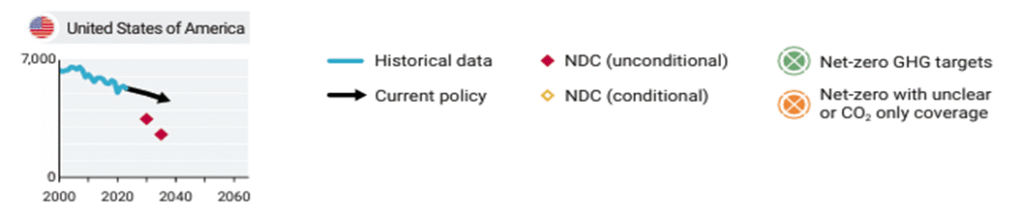
The following graph extract shows the Net Zero Emission target year for a few large countries/parties and the graph-arrow the direction of emissions travel, taking into account their latest NDCs .
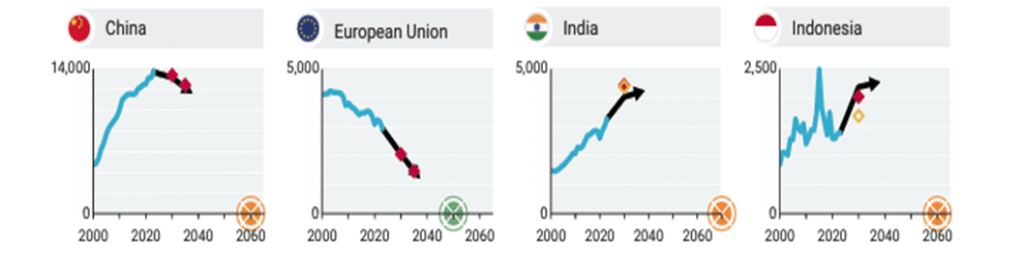
The EU appears to be on course for Net Zero in 2050 across all GHGs (thought the nearer the Zero target gets the harder to achieve incremental reductions). China is showing some reduction but a long, uncertain reductions pathway to its goal of Net Zero CO2 by 2060 lies ahead. And both India and Indonesia emissions would actually go up, leaving, as with so many others national commitments, all the hard work to some future date, if they ever do!
But important to note too that the per head emission rates of India and Indonesia are multiples lower than developed countries and issues of equity arise when considering their emission pathways as indeed all developing countries (referred to in the UNFCCC international agreements as ‘common but differentiated responsibilities and respective capabilities’) .
For the United States, the arrow of travel shows the impact of Trump’s reversals , instead of sharply downward in line with the Biden commitments made (the two red dots in the diagram), emissions would not reach Net Zero till late in this century, if ever, But tellingly still veering downwards due presumably to the economic advantages of growing renewable deployment.
All in all a weak showing as governments pull back from real commitment to abandon the comfort of fossil fuel addiction and confront head on the risks of dangerous global heating possible climate increasing dangers of reaching climate system tipping points.
Emission Gaps is the Actual Gap in our Collective Willingness
The emissions gap measures the difference between current emissions along with current and new emission reduction commitments against the emission reductions actually needed to prevent global heating above 2 degrees or the more stringent lower heating thresholds of 1.8 and 1.5 degrees warming– the thresholds before heating becomes ‘dangerous’ at a global scale as determined by UNFCCC global climate agreements following IPCCC established scientific conclusions.
It comes as no surprise that the emissions gaps are large – the emissions gap based on these NDCs is 25 GtCO2e in 2035 per year – in other words, we need to be burning just about half the amount of coal, oil and gas that we are currently in order to keep the world safe! Consider that the best the new government NDCs pledges can do is shave a further 2.7GtCO2 off (about 1/10th of the reductions needed) off our emissions by 2035 and it can be seen the gulf, not a gap to what is needed to be bridged somehow. The gap to 2 degrees of warming is smaller at 12GtCO2e but that is still huge and at the borderline of dangerous heating conditions.
There is also, depressingly a further gap; the implementation gap – this is the difference between what is being committed (the first gap) and what is actually on course to being implemented compared to what was promised (the second, implementation gap). This implementation gap is a subustantial further + 5GtCO2e – about 2 GtCO2 higher than it was in 2024, largely due to the US backing away from its previous climate commitments.
So, even leaving out the United States, there is not the motivation or interest to properly tackle the problem because it can only be that the problem is not properly accepted or acknowledged.
But it also reveals the difficulty of closing that gap at a time when new renewable installation is actually outpacing fossil fuel deployment over 9 to 1 and deployment coming close to the Net Zero key target of trebling total renewable deployment by 2030 (x2.7) with almost three quarters of new NDCs having renewable targets.
It highlights in fact that the problem lies not with new energy deployment but rather with the replacement of our accumulated fossil fuel infrastructure over a century and more – the failure to address this issue in the NDCs strikes at the heart of the problem. This is a problem that will only likely be solved when enough people demand of their Government to start the beginning of the end for oil and gas and we begin ourselves to make that change. And not as the right wing media would have you think because we are politically correct ‘woke’ boffins but because we are willing to accept the warning of science and know we need to respond in kind.
Faint Glimmers of Hope but with One Big Warning Flash
The Hope…
Yet there are glimmers of hope – compared to last year’s assessment, the emission gaps to 2035 to remain within 2 degrees warming is smaller (6 GtCO2 less, 4 GtCO2 less for 1.5C) so things are at least going in the right direction even if at a snail’s pace! The implementation gap is also noted to have narrowed significantly in several countries, just masked in the overall figures by the large impact of the US withdrawal . More countries are also adopting absolute emission reduction commitments instead of conditional ones which may or may not be fulfilled depending on the conditions stated.
All in all, the total impact of the new policies and commitments mean that peak warming this century, should max out at 2.5 degrees instead of 2.8 degrees previously (excluding the occurrence of feedback factors with nasty surprises).
This would actually go down to 2.3 degrees heating if every conditional commitment was met and down to 1.9 degrees if every Net Zero pledge was delivered though that on current experience would be a big stetch! 1.9 degrees of warming does not sound too far from 1.5 degrees warming but each 0.1 degree involves major incremental effort on top of our total stretch commitments. Still as mentioned, these are faint glimmers of possibility if nothing else at the moment.
…And the Warning
But there is a stark warning from nature – our natural carbon sinks, forests, peat and wet lands, mangroves and oceans, which in the past have absorbed over half our emissions (25-30% respectively in oceans and land), appear to be rapidly weakening so that more of that CO2 accumulates in the atmosphere.
This is reflected in the breakdown of the sources of the increased emissions indicated at the start of this article. As can be seen in the chart below, of the 1,500 Mega tonnes CO2e increase (1.5GtCO2e) in the past year, over half of that came from the land source.
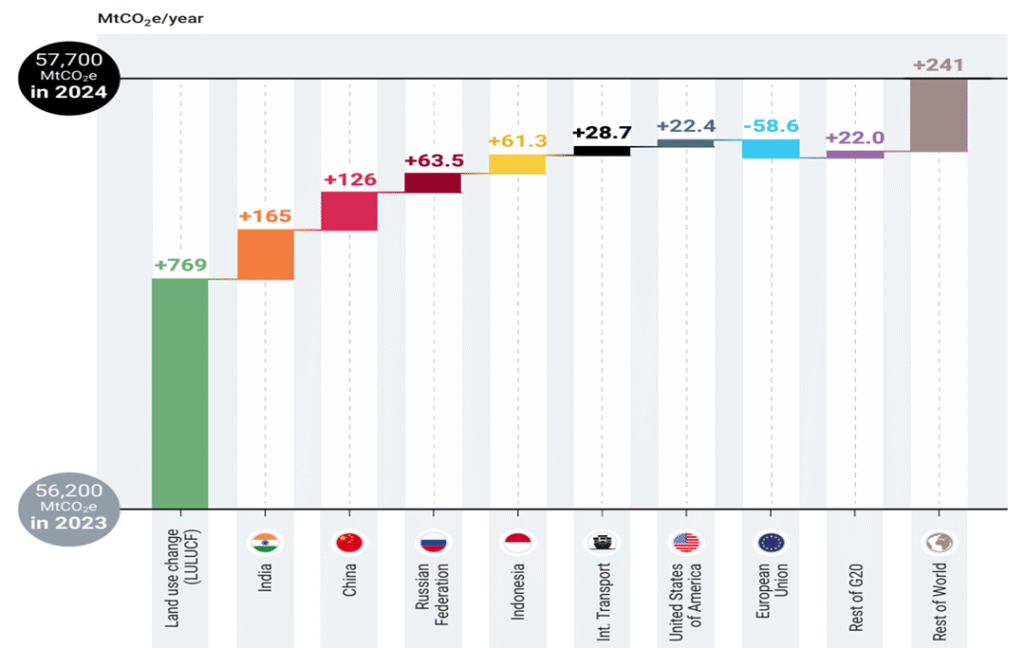
Put another way, if land continued to absorb the same amount of carbon as in previous years , the increase in emissions would have been limited to 1.1% rise rather than the 2.3% actual occurring and reflecting better the impact of our efforts especially related to renewable energy deployment.
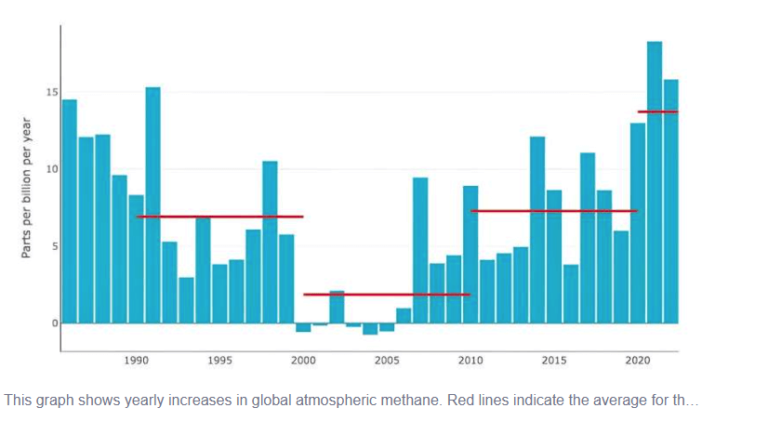
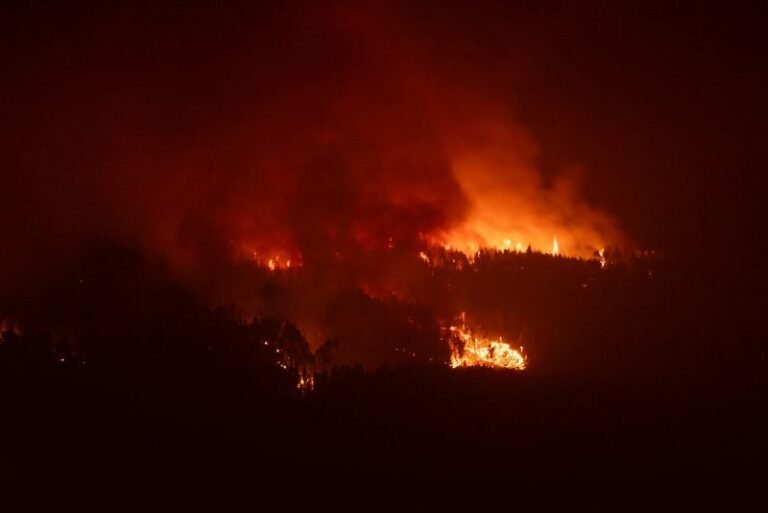
What caused this large sudden carbon outflow from land and forest? Deforestation is an obvious culprit but that has been ongoing for years and in recent years rates have been falling as acknowledged in the report. The answer seems to lie in forest wild fires and the drying out of peatland in the drought conditions created by lack of rain during the cyclical El Nino climate conditions prevailing in 2023 and 2024. – 2023 and 2024 were particularly bad years, remember the forest fires over vast swathes of Canada?
This is a very worrying development as it is in fact a dangerous reinforcing feedback or vicious circle– as we heat the planet, nature’s ability to store our carbon is reduced leading to more carbon stored in the atmosphere resulting in more more and faster heating and the cycle continues.
We have long known of this dynamic and risk but to see the impact so directly, sooner and suddenly in the emissions records is a stark warning – if we continue to heat the planet, we begin to lose control over our own destiny as forces of nature operate to accelerate the carbon emissions, heating and harm caused. This is a sobering realisation that needs urgently more attention. It is an issue that Climate Junction – Which Direction will return to again to explore in more depth at a later date (if you would like this topic covered sooner, please let us know).