It has taken just a few months for Donald Trump to light a bonfire under America’s climate institutions. From tearing up Biden’s clean energy legacy to hollowing out the very science that tracks our changing planet, the new administration has moved with breathtaking speed to dismantle decades of progress. The consequences stretch far beyond Washington — from rising bills and lost jobs at home to weakened trust and leadership abroad. Yet even as the wrecking ball swings, the first shoots of resistance and resilience are already breaking through the cracks.
Introduction:
It has been 6 months or 194 days to be exact since 20 January 2025 when Donald J Trump formally took office as the 47th President of the United States of America. Those days may feel like years to many with dismantling, revoking, hollowing out, sackings and withdrawing that has taken place in that period, particularly in relation to the many US institutions which led the world in the quality of their climate data and science.
This article will look at what we knew before President Trump’s election. Far from being a surprise, we see how he clearly set out his carefully planned agenda for climate and energy policy; how he has substantively implemented those objectives, particularly with the budget law for 2025, the so called Big Beautiful Bill in words that could fit well into George Orwell’s dystopian classic, 1984. We will also consider the specific impacts of that policy for the United States as well as for the rest of the world though it is nota particularly heartening read!
However, the shoots of resistance have already appeared as much in the climate sphere as in others and, as we will see it may be as much the negative implications of his policies on the lives of ordinary US citizens as much as the disastrous consequences for climate action that will shape the fight back. Those impacts may also have a chilling effect on the international scene, certainly related to reduced funding for climate and indeed all international focused action. But again that is not the end of the story and already there are green shoots of resilience and renewal. But first the bad!
From Slogan to Sledgehammer
There were no surprises – from the start, one of Trumps most memorable slogans from the election campaign was ‘Drill baby drill’, promising to open up nature and federal nature reserves to oil and gas drilling.
He also had in sight President Biden’s landmark Inflation Reduction Act (‘IRA’). The IRA massively expanded renewable energy deployment and provided tax credit subsidies for electric vehicles (EVs) and the foundation for the clean power transformation of that most iconic emblems of American culture, the motor car. This kick started a transformation of the whole transport sector from being the most polluting sector in the United States joining the transition to cleaner modes of travel.
Allied to this is the determination to revoke the Obama period 2009 endangerment finding of the Environmental Protection Agency (EPA). This endangerment finding, based on detailed scientific finding, was the a cornerstone of US climate action over the past 15 years, enabling the EPA to restrictively regulate carbon and other greenhouse emissions across a diverse range of economic activity from power plants, industrial sources to vehicles.
We will see in the next section how Trump has fared so far with his sledgehammer promises. But before that it is instructive to look how the Democrats responded to this proposed assault on the fundamentals of US climate action during the election. The sad thing and perhaps the most telling reflection on the state of public support for climate action in the USA is, they that they did not have much to say. Yes indeed, Democrat climate policies were solid if not revolutionary; principally a re-commitment to the IRA but Kamala Harris backed off from a full bodied attack on Trumps climate and energy policies. Still less leading with any new climate policy proposals while at the same time talking up US oil and gas exports in the disappointed hopes of winning over fossil fuel producing states .
Day One: Lighting the Bonfire
In an ironic contrast, one of the most positive and powerful things that can be said about Donald Trump is that he generally does what he says he will, albeit in this case with disastrous consequences for effective climate action. Except of course he doesn’t believe in climate action having called climate change a ‘hoax’ and his former EPA chief labelling it the ‘climate change religion’; bizarrely in view of its overwhelming scientific basis. Indeed it is a classic case of transference and the remark tells us a lot more about the ideological rejection of climate science of the Trump administration but nothing about the growing climate storm gathering.
The degree of this rejection by the new Trump administration is demonstrated by the early actions to hollow out and disband key Government institutions. Institutions that have led the way in terms of our understanding of climate change risks and research into clean technologies which can make a meaningful dint into reducing those dangers.
declared an ‘energy emergency’ ( perversely echoing the ‘climate emergency’ declared by many countries) giving effect to his ‘drill, baby drill’ mantra, and promoting expanded oil and gas exploration
Exited the Paris Agreement again and all its related groupings, releasing it from its commitments to reduce US emissions by between 61-66% from 2005 levels by 2035,
revoking the ‘electric vehicle mandate’ which was in fact a regulatory emissions standard driving the take up of EVs,
eliminating 80 Biden era initiatives which brought climate justice into the heart of the US administration, including the National Climate Task Force, Environmental Justice Council and Climate Change and Health Equity Office and
ending offshore leases for wind farms.
Trump action in the following months showed his administrations determination to effectively neuter US climate science by:
dismissing the author of the National Climate assessment weeks before its publication was due – the country’s leading and most trusted climate report covering US sea level rise and city flooding risks, drought risks related to food production, wildfire risks and respiratory dangers;
Preparing to remove the EPA’s Endangerment Finding on non-scientific grounds – described as ‘the Holy Grail’ of climate rules – the ruling from 2009 that enabled the EPA to mandate greenhouse gas emissions reductions across sectors and acted as a major driver under the legislative authority of the Clean Air Act and the Clean Water Acts. In 2007, a key supreme court ruling the Court indicated that the Acts permitted but did not require the agency to regulate greenhouse gases. Using this legal basis rather than the underlying scientific rationale, the EPA under Lee Zeldin plans to end the endangerment finding.
But disbanding the whole historic scientific infrastructure on which the US’ response to climate change is based does not of course mean that those risks and dangers disappear. But it does mean that the risks are increased by the lack of knowledge, lack of preparedness and lack of connection between events and their underlying causes. This was tragically seen in the recent devastating flash floods in Texas where climate warming was at a critical contributing factor to the ferocity of the flooding.
“Like King Canute commanding the tide to stop advancing — only Trump actually believes he can.”
Like King Canute commanding the tide to stop advancing while the waters began to lap at his feet. But the difference being that King Canute never believed that he controlled nature, in fact the whole purpose of the display was to demonstrate to his courtiers the limits of his powers; a lesson apparently lost on the current US administration. No matter how much they try to bury the science; the reality of climate change will continue to be experienced and worsen whether that is acknowledged or not by the powers that be.
Slash, Burn and pay More
The ‘evisceration’ of climate policy gives what theoil industry most wanted and carries out exactly out what was planned by Project 2025, the masterplan for government devised by the Heritage Foundation (see Context Article – Engagement Opposition ). Trump during the campaign actually distanced himself from the Project 25 agenda as it was perceived as too extreme but once in power he now appears to be implementing piece by piece, none more so than for climate energy.
Higher Energy Costs – reports vary from 22% increase for most impacted areas like Texas, hosting the largest renewables energy deployment in the country (ironically for a solid Republican state). Other Republican states like Wyoming, North Carolina and Tennessee will also be significantly affected with estimated energy costs increases of between $115 and $314 per year and nationwide, an average increase of up to $192 per year by 2035.
Higher Transport Costs – There will be an estimated 34-70 million fewer EVs on the road following elimination of the EV tax credit and removal of the EPA vehicle standards – motor gasoline consumption is calculated to increase by 4-11%,, pushing up gasoline prices by 1-3%, despite one of Trump’s key stated objectives to reduce motor costs.
Green Jobs -For EV, battery storage and charging production, the Washington Post, estimates that up to 130,000 direct jobs will be eliminated; key states affected being Michigan, Texas and Tennessee. In clean energy up to 400,000 jobs lost or abandoned in solar, storage and clean hydrogen production overall. In the first 3 month period alone, AP estimates 10,000 clean energy jobs had already gone from January to May. Forbes estimates 790,00 jobs lost will be lost overall; substantial figures by any standards and often in strong Republican territories.
Green Exports – the Guardian highlights analysis which suggests that repeal of Biden’s major climate policies could divert $80bn of clean technology investments to other countries with another$50bn in lost exports; opportunities gleefully picked up by China and other countries.
Clean Energy – Aurora Energy Research is reported to estimate a reduction fo 212GW in wind solar and battery storage deployment by 2040. Rhodium goes substantially further and indicates a ‘massive change to the makeup of the electricity grid losing up to 790 GW of new clean power capacity by 2035 relative to Biden era estimates.
Emissions – With all the various forms of negative impacts, it is easy to loose sight of the climate crisis that is the underlying purpose of the climate action of the Biden era and before. Early in 2024 Carbon Brief in a widely cited analysis, estimated the impact of a Trump victory at 4 billion (giga) tonnes of CO2 emissions by 2030 .
Reflections on the policy
A number of quotes from people on the ground most accurately reflects reactions:
The World Resource Institute statement following the adoption of the Trump’s Big Beautiful Bill, reflects on the damage at a time when energy needs are sky rocketing:
“Fossil fuels alone won’t meet the skyrocketing energy demand from manufacturing, AI, electrification, and increasingly frequent and intense heat waves that prompt more AC usage. But America can create a more flexible, agile, and resilient power system with renewables and grid upgrades. Clean energy sources are better positioned to come online quickly to meet growing electricity needs and spur economic growth. That’s exactly what companies, state and local governments, utilities and families have been counting on, planning for and investing in.
‘Lower oil prices driven by tariff-related economic concerns and increased OPEC+ production are hurting profits in the oil sector. Service companies struggle to pass costs to customers, with some vendors potentially facing survival issues. The survey highlights how Trump’s trade policies are creating headwinds for the domestic oil industry despite promises to boost US energy production’.
But the costs go far beyond jobs and bills – they cut into the very science that tells us what is coming.
Leaving to last this, the short but telling quote from a NASA official in a Grist article on the impacts of the programme on scientific endeavour in the United States:
“Essentially everything that is related to how we understand climate is on the table for being cut,” said a scientist who has worked at NASA and who requested anonymity.
“We’ll just be flying blind while the planet is undergoing some of the most significant impacts and changes that have been experienced.”
International perspective –
The World recoils but some ask why are asking why should they even try now.
None of the above has even touched the impact on the rest of the world of Trump’s policies. What is clear however is that the preeminent role of the US in climate science has been voluntarily vacated with much loss in prestige and status to the country. But the rest of the world also suffers from the loss of critical climate data produced by the filleted scientific institutions.
The withdrawal from the Paris Agreement by Trump has been met with an overwhelmingly negative response from other countries who have described it as an abdication of responsibility. It impacts not only its status in the world but also its ability to influence the annual global proceedings to avoid dangerous levels of global heating (close as are now to that defined threshold of 1.5 degrees) at UNFCCC. Worse from a US perspective, it also hands that leadership role by default to China, though whether that is an obstructive or constructive role remains to be seen. But US withdrawal from the Paris Agreement may not be such a bad thing in the view of some as Trump cannot derail the efforts of the rest of the world in the coming negotiations in Brazil in November, marking incidentally the 10 anniversary of the Paris Agreement.
The danger as this BBC article points out is that other countries start asking the question, ‘if the US is not making an effort why should we‘? This highlights the highly corrosive effect that such actions have on international cooperation, contribution and trust; essential ingredients for successful internationally shared outcomes. The article highlights how Argentina under the right wing President Milei is also considering pulling out of the UNFCCC global climate process. It also signals that the climate commitment of Indonesia,, one of largest carbon polluters, has been put at risk, pointing to the massive imbalance in emissions:
“Indonesia produces three tons of carbon [per person a year] while the US produces 13 tons,” he asked at the ESG Sustainable Forum 2025 in Jakarta on 31 January. Yet we are the ones being told to close our power plants… So, where is the sense of justice here?”
Of course Indonesia has a valid climate justice point to make, it is just that the Trump Administration doesn’t care and the rest of the world pays the price. The price is in terms of a weakened international system, where the strongest are expected to contribute the most but the strongest of all is now seen to act most vehemently in its own narrow, short-term interest, to the detriment of all.
The Fightback begins
Resistance in the States –
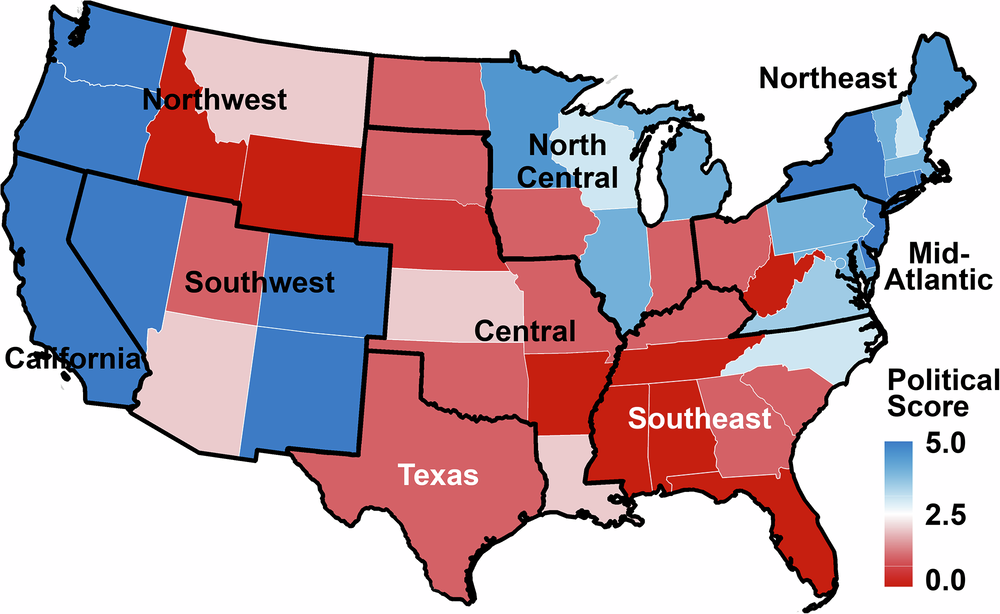
But at City and State level, there is already a strong momentum towards a clean energy transformation which is working independently to what happens at Federal level. Important in the context of that optimism is an article; State-led climate action can cut emissions at near-federal costs but favours different technologies published in the leading academic journal, Nature. Th e piece calculates that similar emission reductions to what was promised under the Biden administration can be achieved from the 23 ‘climate minded’ states continuing to pursue their own net-zero emissions policy objectives and targets.
The article calculated that if those 23 committed states (showing blue in the map extract from the article) actually achieved their Net Zero goals it would result in carbon emission reductions for the US as a whole of about 46% by 2050.
Fig. 1: Political score used to identify net-zero ambition states.
The article then compared what it would look like if all continuous 48 states together achieved that outcome by 2050 and found a difference of only 0.7% in the total cost between climate-minded states compared to all states approach (though the decarbonisation pathways taken would be significantly different which would more on the particular state features and strengths rather than a broad national approach).
But still, this State led approach outlined in the article results in significantly less than 100% Net Zero by 2050, the scientific marker for keeping the world within relatively safe warming limits. So the basis of the article’s optimism is in terms of the overall costs or reduction, rather than the scale of emissions reduction achieved being less than half what is needed.
Trump Attacks State Freedoms –
Yet, the above Nature article analysis does not take account of the particularly aggressive Federal approach to restrict the rights of States to pursue their own climate action. This is most evident in the revocation of the waiver that permitted California to pursue stronger emission reduction standards than those that apply under EPA emission standard regulations to the rest of the country. This Californian waiver required 35% of new vehicle sales to be electric in 2026, rising to 100% by 2035 (matching the commitments in the EU and UK). The US Senate has voted across party lines to terminate that waiver even though the legal procedure used to do so is suspect. California intends to appeal though with a Supreme Court largely quiescent to the wishes of President Trump, prospects for a successful outcome must be regarded as slim.
As can be seen by the California response, states committed to meaningful climate action will not be so easily put off. Over a dozen state attorneys general from California, New York, Massachusetts, New Jersey, Maryland and others have filed lawsuits opposing the rollback of six key EPA rules targeting coal power, methane, transport emissions and landfill pollution.
New York has also established a Climate Change Superfund Act which requires fossil fuel producers to fund resiliency infrastructure in light of the climate damage their fuels generate which several other climate activist states including California and New Jersey are considering. It will come as no surprise that Trump has already started legal proceedings to prevent these actions but which New York has indicated it will strenuously defend.
Trumps Anti Clean Energy Action – Contains the Seeds of its own Demise?
Economic Impacts –
But, it may be that it will be the non-climate impacts of an economically and socially illiterate policy which limits power production and cuts jobs and reduces national revenues will have the most direct and immediate impact on the US general public. We have seen above how energy costs are expected to rise significantly. Energy itself may become in shorter supply as energy hungry data centres multiply as AI energy demand soars. Losing the flexibility and speed of deployment of renewable energy may be something that the Administration will experience in this term of office and be there to regret.
The impact of good quality, clean energy job losses, estimated in their hundreds of thousands, will be another major negative factor bearing down on Trumps anti climate policy, especially when those job losses are located in prime renewable energy states such as Texas for solar (the country’s largest producer) or Tennessee for wind. All strongly Republican states that will suffer directly from the shortsightedness of the new Trump policies; in denial not only of science but also of economics wich bread and butter issues for millions of Americans no matter what their political colours are. Add to this, the loss of the global competitive edge in leading and soaring green technology potentials such as in battery technology, direct air capture and several other next generation technologies.
Climate Impacts –
And as in clean energy, so in climate science, the loss of US climate science leadership will directly hurt the prestige, status and influence of the country on the future development of understanding on critical climate data on including extreme storms, flash flooding, drought, forest fires, food production and farming techniques, warming seas, deoxygenation, marine dead zones, coral loss and marine ecosystem collapse, ice sheet melting, sea level rise, gulf stream collapse risks; the list goes on and on.
The loss of the ability to gather critical data, interpret it and warn will be a major hindrance to the ability of the country to anticipate these climate hazards, prepare, mitigate and adapt. No matter how such risks are labelled, the deteriorating climate will continue to have a growing negative effect on the well being and security of its citizens and whether it is acknowledged or not, except where the science and impacts is not acknowledged then it becomes a self inflicted blindness.
“A deliberate unlearning”
Conclusion –
Compounding all these dangers is a lack of climate literacy at the highest levels. Trump’s public denial of climate science, disdain for environmental institutions, and marginalization of expert advice further reduce the nation’s capacity to understand, anticipate, and respond to the intensifying climate crisis. This epistemic erosion — a deliberate unlearning — is perhaps the most damaging legacy of all: a nation increasingly exposed to climate harm, led by a government increasingly unwilling or unable to recognize it.
As the 2020s unfold, the risks of inaction are no longer abstract or distant. They are materializing in lived experience — in insurance collapses, heat deaths, flooded cities, and failing harvests. Against this backdrop, Trump’s climate reversals appear not only reckless, but dangerously out of step with the realities of a warming world. But the stakes will increasingly not only be at a macro economic level, but affect the essential conditions for living a decent life in the United States:existential threats. All because of the deliberate blindness and willful unlearning of this administration.
But this state of affairs will only be tolerated for so long before the toll of such economic folly and growing climate anarchy becomes simply unacceptable.
The experience will remind us over time of the true reason and purpose of climate action, for that we can be grateful; provided it is not too late by then of course.