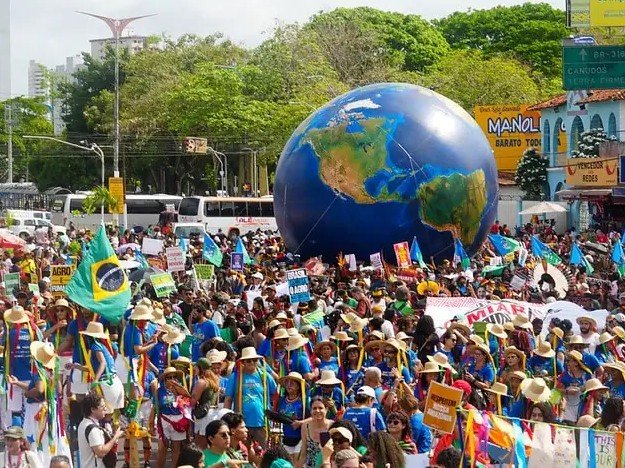

The Climate Engagement Conundrum 1: broad support but shallow?
Overwhelming support for climate action according to polls –
There is a paradox at the heart of the climate debate. Public support for action has never been stronger — and yet emissions are still rising. Understanding why is perhaps the most important question in climate politics today.
More than four out of five people agree that climate change is real. It would be hard to deny with the almost daily evidence of climate chaos on our TVs. from wildfires in the Americas, north and south, extended droughts in Africa devastating both wildlife and livelihoods and major flooding incidents right across the globe. Indeed we now apparently experience climate whiplash where conditions switch from parched soils and dried rivers and reservoirs in one month to raging river torrents and devastating flooding in the next such as in Texas in July 2025 where 125 people died or in Valencia, Spain in November 2024 where over 220 lost their lives.
But the big numbers supporting climate action don’t end at support. In the largest ever survey on climate change undertaken by the UN in 2024; over 80% of the population surveyed across the globe think that their government should do more; a consistent finding across many such results. A Guardian article on the topic reported something more significant perhaps – that over two thirds of people were willing to pay for action– not demand that ‘governments’ should do more but were actually willing to contribute from their own pockets to pay for effective climate action.
If that were translated into reality, the sums raised would convert into 100s of billions, if not trillions of dollars; going a long way to meet the developing world’s climate mitigation costs of $1.5 trillion per year, as estimated in 2024. In countries where fossil fuels are central to their economic activities; the majority willing to contribute is even greater – 97% in China, 80% in the petrostate of Saudi Arabia!
Social Tipping Points –
This apparently overwhelming support for climate action is important for a new concept of a positive social tipping point gaining recognition– the mirror opposite of the much discussed climate tipping points. Just as in climate tipping points, where a certain threshold is reached such that one further small push can set in motion a large scale self-reinforcing shift to an altered climate state. It is argued that the similar can happen in the social context but in a positive way when the uptake of meaningful climate action reaches a certain point of momentum which generates a permanent shift in behaviours towards lower carbon behaviours, lifestyles and in the broader economy.
This might involve, for example, large scale switching to electric vehicles or heat pumps which greatly reduce the carbon footprint for transport and home heating, major sources of GHGs respectively. The key point being that when enough people make the change, a wholescale shift in behaviour towards lower carbon alternatives can occur quiet quickly. This shift is adopted collectively by choice, though often facilitated by government supporting policies such as subsidies or standards but which critically as the support of the general public.
The Climate Engagement Conundrum –
One might think that the sheer number of people that acknowledge climate change and its corresponding risks as well as the massive majorities supporting government action, even willing to contribute financially towards that action, should result in some of these social tipping points happening in one country, being taken up in another and so on in domino fashion.
Indeed it is true that the growth of renewable energy is beginning to make serious inroads into the dominance of coal, oil and gas power production. Solar alone has trebled in capacity in the past 5 years and renewables contribute overall a massive 92.5% of total new power generation capacity growth in 2025 according to IRENA, the global renewables representative body. This is particularly true of China which alone accounted for over half of new global renewables capacity in 2023.
However the same IRENA report also notes that the world is still a long way from the global goal of trebling renewable energy capacity by 2030 (committed by the 29th CoP in 2024) and considered essential to have a chance of meeting Net Zero carbon targets by 2050.
To align with that 2030 global goal, total renewable energy capacity needs to reach 11,200GW (Gigawatts or billion watts) from 4,450GW today. Simple calculation shows that new renewable capacity installations needs to double from 600GW currently to approximately 1,200GW installations per year in order to reach this target.
China is leading the world by a long way in this regard – if renewables were installed at anything like the same rate in the rest of the world, this would take us to the rate of renewables deployment needed. Not just meeting new demand but displacing existing polluting fossil generation facilities with clean renewables sources, which is exactly what is needed.
So what is happening in the rest of the developed world? Is that deep well of climate action support being mobilised globally to support and demand the transition from carbon polluting oil, coal and gas energy generation towards clean renewable sources? This question takes us to the heart of the climate engagement conundrum.
Opposition to renewables and other carbon reduction measures
Donald Trump was elected on a platform of driving an energy revolution, but not based on renewable energy deployment but a policy of ‘energy dominance’ centred on fossil fuels under the simplistic slogan of ‘drill, baby, drill’. A position he restated in his recent state of the union speech; regardless of the impacts that would have and is already having on energy generation and rising prices. The point is that he was elected with fossil dominance as one of his flagship policies, that and taking the US out of the global climate framework agreements.
Even the Democrats who under Biden had introduced the world’s largest renewable incentive package, did not campaign on their climate credentials or renewables track record for fear it was an unpopular policy and the prospect of a political backlash. Hardly a reflection of that groundswell for climate action suggested in the surveys nor convincing evidence for reaching some form of social tipping point driving further widespread adoption.
But this resistance to renewables is not limited to the United States – local opposition at planning level regularly blocks development of new solar and wind farms not only in the US but also in the UK and Europe. Large wind farms are often located out to sea, in part to minimise these objections but the opposition then simply shifts to the installation of pylon lines, essential to carry that power across rural areas to urban centres where the most demand exists.
Local opposition ranges from the visual impacts, loss of agricultural land and lack of local benefit or consultation (many of which could be addressed in a considered and equitable manner).
However, the argument for the purpose and benefit of renewables and the supporting grid infrastructure are either not heard or are actively discounted.
Political backsliding
Populist parties such as Reform in the UK, are making a campaigning issue of their opposition and are surging ahead in the polls and in local elections. The Tories in the UK have abandoned the long held political consensus supporting the landmark Climate Change Act 2008 which mandates ever reducing carbon emissions (budgets).
Similar dynamics in the US, EU are affecting the mass adoption of other critical carbon reduction measures, such as installation of heat pumps in the UK in place of fossil gas boilers and the switch from internal combustion engines to electric vehicles in the EU, both greatly more energy efficient as well as being cleaner sources of power.
It may be true that switching to renewable energy, whether at national level or personal, costs more in upfront capital costs compared to their fossil fuel equivalents. Although those costs are coming down and over the lifetime of the asset, costs are comparable or actually lower due to significantly lower fuelling costs as well as higher energy efficiencies.
However more honesty about the higher initial costs of purchase would demonstrate the courage of conviction and draw attention to climate action as a key driver and urgency for the energy transition in the first place. But if climate action support was vocal and active as we are told; you might expect that that support would make its voice heard loud and clear. Demanding for example, effective tax funded subsidies to make the clean transition more affordable for people, diverting subsidies towards oil and gas for the purpose.
The fact that governments are so reluctant to talk directly about climate action being the key motivator; emphasising other benefits instead such as energy security tells us a lot about the current state of climate discussion in the world today. If politicians were confident of public support and backing for such climate action then with their finely honed ear to popular opinion, they would loudly and proudly broadcast the benefits and their support for rapid and effective climate action measures.
Wide but shallow support?
So while poll after poll points to widespread support for climate action, that support would seem to be at best dormant and at worst illusory; at least as far as key policy decision making is concerned in the developed world related to real carbon reduction action.
Part of the answer may indeed lie in what the Guardian article on climate polls, discussed earlier, has called the ‘spiral of silence’. This is a reference to further consistent poll results which suggest that whilst people indicate they are concerned about the climate, it appears people also consistently underestimate the commitment of others as well. It highlights a poll in the United States which indicated that people believed about 40% of fellow citizens supported climate policy when in fact 75% was the actual figure.
This mismatch apparently extends to politicians: according to a 2024 poll referenced, over 7 people in 10 support onshore windfarms but only 19% of parliamentarians believed there was a majority of their constituents who supported such a policy. Even for the UK anti climate action party, Reform, apparently 62% of its supporters want the Government to tackle climate change.
Is it all a case of yes please but not in my backyard thanks, the infamous nimbyism writ large, or all a case of ‘lies, damned lies and statistics’ in the famous phrase attributed to Mark Twain? Or are we in the words of Anthony Leiserowitz of Yale University, quoted in the Guardian article:
… sitting on an enormous potential climate movement. It’s latent. It hasn’t been activated or catalysed. But when you break through these perception gaps, you help people understand that they are not alone and there is in fact a global movement.’
While I believe the statistics are not wrong or at least not so wrong that only a minority support climate action, I also do not think that it is simply a matter of being aware of climate change and its danger – after all, literally thousands of organisations and bodies, government and non-government, have been making that case for decades now yet still emissions continue to rise.
People are going about their business; driving, flying, heating pretty much as they always have, using predominantly fossil based fuels to do so despite the clear impact on the climate. There must be something more to it and that is what we will look at in the next instalment.
The next article looks beneath the surface of that support — into the psychology of avoidance, the politics of inertia, and the forces that have worked hard to keep it that way.