Disappointments at COP30…. But something Big is Bubbling from Belem!
Introduction – COP30 background
This is the 30th anniversary of the founding the UN Framework Convention on Climate Change in Rio De Janeiro and 10th year anniversary of the climate landmark Paris Agreement which introduced structures intended to limit increases to below 1.5C and in any case to hold temperature increases well below 2C.
While the scientific consensus is that we are within just a few years of exceeding the 1.5C limit and the outer 2C limit could be breached within a decade or two, it is also fair to say that the rate of greenhouse gas emissions has slowed dramatically following the adoption of the Paris Agreement; from 1.7% rise per year in the decade before 2015 to just 0.32% in the 10 years since the Agreement.
This year, fittingly enough, COP30 (the annual COP process where countries come together to agree ways to achieve the Paris Agreement objectives ) returned to Brazil. It was always going to be an auspicious occasion made more so for the location in Belem in the heart of the Amazon; one of the key biospheres directly at risk from climate change.
An Auspicious COP30
COP30 was billed in advance by the Brazilian President Lula as the ‘COP of Truth’ and the ‘COP of Action’ but it was taking place against a more ominous setting. President Trump is withdrawing from the Paris Agreement process and did not send any representatives to this COP; significant in itself because of the financial might of the United States and creating a potential vacuum after the US climate commitment and leadership from the Biden years.
But more concerning perhaps, the recent role the US played in scuppering the International Maritime agreement to introduce a carbon cap and trade system for global shipping; successfully threatening countries who supported the agreement with sanctions, in the end that agreement was postponed, at least it wasn’t cancelled! Would he do the same in Belem, even from a distance?
In this context, reaching an agreement at COP30 at all going to be an achievement and a relief to all present when it did. It very nearly didn’t happen at all; not this time because of the usual suspects, the Arab Group and other climate action laggards, but from a wholly unexpected and indeed hopeful development; the demand for roadmap for the start of the end for fossil fuels. Although the demand for a roadmap did not make it to the final text agreement, it has lit a flame that will not easily be quenched again.
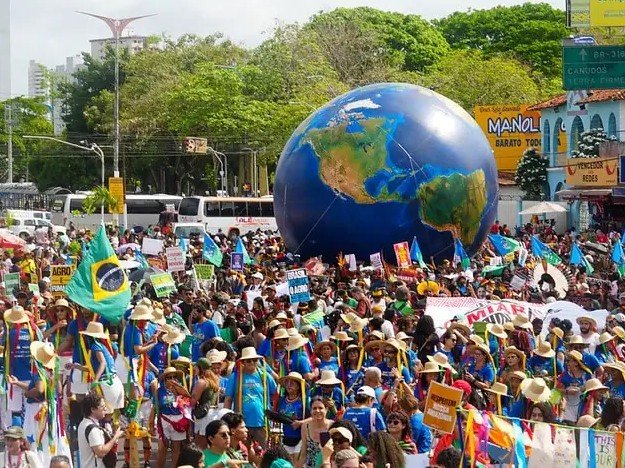
This demand started not in the political halls of the meeting place but on the streets when tens of thousands of people marched in Belem to call for an end to the burning of fossil fuels, led by indigenous Amazonian groups; a call taken up by scores of countries in the negotiation chambers, though it wasn’t even on the initial COP3 agenda!
We will look at how that developed and what it means for future negotiations but first to look at four key outcomes that were agreed at COP30 and what wasn’t.
COP 30 Outcomes
Drawing from the comprehensive review of proceedings prepared by Carbon Brief, following are notes of key outcomes contained in the Global ‘Mutirao’ Decision, a Portuguese word derived from Amazonian indigenous language meaning working together towards a common purpose:
Adaptation – the final decision ‘calls on’ countries to treble adaption finance by 2035. OK, so it is not clear if this is a trebling of current pledges or current actual payments, a very big difference (!); or whether indeed it will be additional money at all or simply redirected taken from the climate mitigation funding.
It is only a ‘call’ but being treated by developing country groups as binding; beware to any developed countries who try to argue otherwise in the future! Allied to this is the adoption of 59 indicators of adaption to measure progress. Regarded as a major achievement of COP30 but worth noting too that ‘adaptation’ is also an acknowledgement of inevitable climate harm; responding to the impacts and building resilience but not the underlying causes; predominately fossil fuel burning and land use.
Ambition and the 1.5 target – A sad but important reality check that 1.5C is now in sight and will likely be exceeded (‘overshoot’) but the extent and duration must be limited – if taken seriously this would need to involve immediate and swinging reductions in oil and gas burning – who is ready?
Agreed a voluntary and vague ‘global implementation accelerator’ (GIA, acronyms sprout like mushrooms in the COP world!)– vague because no obligation or funding figures indicated and voluntary because no obligation to act. Here would have been a good place at least to mention fossil fuels and it was included in earlier drafts but later edited out – the COP process proceeds by consensus which is like the lowest ambition all will accept and this is an example in action. It was on this point that the drama on the fossil fuel roadmap unfolded which we will look later in this article.
Climate Finance – the last COP29 in Baku was earmarked as the ‘finance COP’ and agreed climate mitigation funding of $350bn annually by 2035; though still a fraction of the funding identified to be needed, $1.3 trillion to keep within safe warming thresholds. It was left to COP30 to see if that commitment could be advanced – it short it wasn’t!
The remaining principal funders after the US departure; EU, Japan, UK are pleading poverty (as though a climate in breakdown will not affect them). Technical debates about the source of funding, public funded grants or private sector loans (no prizes for guessing which is preferred!).
In the end though, some surprising and encouraging strong legal language made it into the final text ‘deciding to urgently advance actions to scale up finance to $1.3tn’. A promise go on talking more perhaps but also a clear marker for the future. A promise and outcome, that hopefully countries will be held to again by climate activists support in the future.
Transition – Another outcome which was considered a real victory relates to the ‘just transition work programme’ which is intended to support communities that are more impacted from the switch from carbon polluting energy production such as coal and gas to low carbon generation. Started in 2022, it has come front and centre this year at COP30 with the adoption of the ‘Belem Action Mechanism’ (BAM).
Explaining the sense of victory in the adoption of BAM, even though by itself it is just that a mechanism, Annabella Rosemberg for CAN International, quoted by Carbon Brief states:
‘the just transition mechanism comes with the most progressive rights-based framing e have ever seen in a Cop decision. For the first time, labour rights, human rights, the right to a clean environment, ‘free, prior and informed consent, and the inclusion off marginalised groups are al recognised as core to achieving roe ambitious climate action…This is our victory carved out despite all the odds.’
And What Didn’t happen…
Agriculture and Food Security – Developing countries wanted support with implementation measures, in the end nothing was included in the final decision on this critical climate risk as so recently highlighted in this Guardian article.
Climate Science – No mentions on the current state of the climate – reference to ‘the three hottest years on record’ dropped, no direct endorsement of the Intergovernmental Panel on Climate Change (IPCC) monumental Assessment Reports as representing the ‘best available science’ or indeed the need to counter an ocean of climate misinformation, often deliberately spread. A weak showing for this ‘COP of Truth’!
COP Reform – It is not easy to strike a balance between the need for climate action and the need to have full global engagement in the form of consensus decision making but very little progress was made to streamline the sprawling, complex and confusing procedures, described by one commentator in the end as a ‘nothingburger’.
Procedures that seem to bury the issues in a morass of procedural technicalities, often to mask the lack of commitment or willingness to fund the transitions needed to clean energy sources. But for now, it is still the best we have. Indeed the only place that the world comes together every year to work out how to fight climate change and as noted earlier actually beginning to bend the global emissions curve even if not by a long shot fast enough.
But What ‘Big’ is Bubbling….?
The phase out of fossil fuels is now firmly on the COP agenda; although you would not necessarily be able to tell it from the indirect, obscure text itself in the final ‘Mutirao’ decision. But it marks an important victory, possibly the most important win of COP30. In a serious head to head Saudi Arabia threatened to veto any result including such a commitment confirming perhaps the worst fears at the outset for the process.
This started with the demand for action from the protestors on the streets of Belem for a fossil fuel phase out ‘roadmap’. This call was heard and taken up my a number of countries which with only two day to close had grown to 80+ countries and not even on the formal COP agenda beforehand.
The proposal briefly appeared in the draft final decision text before being removed again at the insistence of an unidentified ‘large’ number of countries (many countries suspected denied participation to Carbon Brief), led by the Arab Grouping. Dozens of countries seeking the commitment to a phaseout roadmap threatened in an open letter to walk out of the proceedings, Colombia held up any conclusions being bull-dozed through by the chairman.
Late into the night, Saudi Arabia relented and agreed that the initial and so far the only reference in COP negotiations to a transition away from fossil fuels, made at COP 28 (ironically perhaps in Abu Dabi), would be affirmed. That was it!
But it was and is big. Having spent two years trying to roll back from that perceived ‘overreach’, COP30 has reinstated it firmly on the current and all future agendas; there is no going back.
A fossil fuel phase out roadmap express commitment may have been too much for this COP30, but a new conference will take place in April 2026 in Colombia, joint hosted by the Netherlands to take this forward. The whole world does not need to approve or even attend; just those who are ready to start that journey and we have seen how already 80+ countries are willing. Finally the elephant in the corner is starting to trumpet, echoing the people in the street. It will be down to each country and all climate activists of every shade to make that call of their countries to join and to meaningfully participate.
This is where engagement comes alive to repeat the impact from the streets of Belem. Not before time, but the time is now! We at Climate Junction are seeking ways to participate too and people to help – delighted if you would consider joining, if you may be interested, please see Team section in the About page for more – there are lots of ways you could help About Climate Junction – Climate Junction😊.
Have a great holiday break, will be back in 2026!
MCL, December 2025.