
Context – Climate Change Impacts – Extreme Weather
Contents:
- Introduction
- Climate Change Impacts –Temperatures
- Climate Change Impacts – The Water Cycle
- Article Links
1. Introduction
The purpose of this Context article is to provide a basic explainer of the climate change impacts on weather and in particular weather extremes. The article utilises key selected extracts from reputable sources extracts are copied in italics and parts highlighted in maroon for emphasis.
The aim is to set out in summary, the climate change drivers as well as the effects and impacts on forests and biodiversity currently experienced as well as the likely committed changes and possible future consequences, depending on the climate change pathway into the future. This future pathway is itself dependent on the global Greenhouse Gas (GHG) emissions trajectory particularly from Carbon Dioxide (CO2) and Methane (CH4) and whether these continue to increase, level off or are reduced and at what speed committing the world to warming of 2.7 degrees on current trajectories or other outcomes; the actual outcomes being in our power and control.
There will be some overlap of themes across the Context articles as climate change does not operate in discrete categories (in fact cross over impacts and feed-backs are one of the defining features of climate change greatly complicating the challenges.)
At the end a number of links to recent articles are listed which provides further information and evidence of the impacts, this list will be updated from time to time to keep current. A basic outline of greenhouse gases, emissions and temperature rise is provided in the short Impacts – Introduction Context article
2. Impacts – Warming Temperatures
Extract From Climate Change: Regional Impacts | Center for Science Education
Changes in Earth’s climate have different effects in different areas of the world. Some places will warm much more than others, some regions will receive more rainfall, while others are exposed to more frequent droughts. Regional changes in temperature and precipitation are having impacts on people and ecosystems. Animals that are not able to tolerate changes in climate and are not able to move into new areas are threatened by extinction.
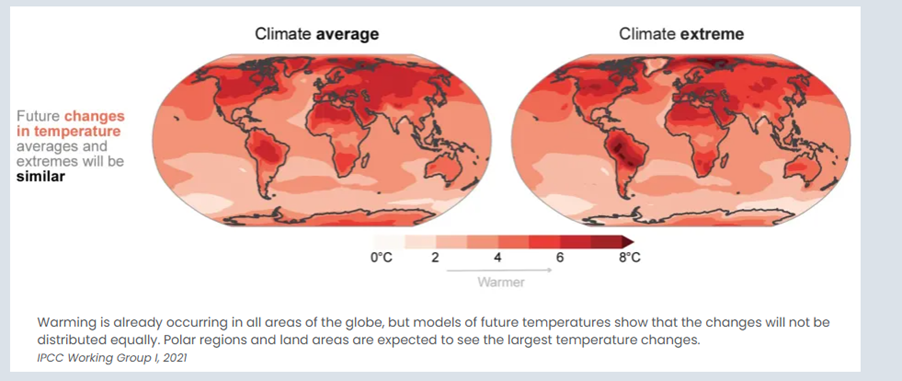
Earth’s average global temperature is rising, but the amount of warming is not equal in all areas of the world.
- As the climate warms, the ocean is expected to warm more slowly than land because it takes much more heat to warm water than air and land. The air right above ocean water are expected to warm more slowly than land too.
- In general, the middle of continents are expected to warm more than coastal areas. Regional topography such as mountain ranges will influence this too.
- At high latitudes, especially in and near the Arctic, temperatures are warming faster than places closer to the equator. The Arctic is heating up about twice as quickly as the global average.
Global projections
Extract From UK and Global extreme events – Heatwaves – Met Office
The IPCC AR6 report states it is virtually certain that further increases in intensity and frequency of hot extremes will occur throughout the 21st century. On land, there is high confidence temperature extremes will increase at a greater rate than global mean temperature increases.
Higher temperature extremes mean that there is a bigger risk of regions becoming difficult for humans to live and work in. At 2 °C average warming above pre-industrial levels, the number of people living in areas affected by extreme heat stress could rise from 68 million today to around one billion. A further increase to an average of 4 °C above pre-industrial temperatures could see nearly half of the world’s population living in areas potentially affected by extreme temperatures.
Hurricanes and Climate Change
Extract From Hurricanes and Climate Change | Center for Science Education
In 2017, Hurricane Harvey decimated the Texas coast around Houston, causing catastrophic flooding due to a record amount of rain. Harvey, which came ashore as a strong Category 4 storm, weakened and then stalled. Over four days, as the storm wandered along the coast, many areas received more than 40 inches of rain (and some got up to 60 inches) causing major flooding, causing over a hundred billion dollars in damage, and displacing more than 30,000 people.
Hurricane Harvey was very unusual but will we see more unusual hurricanes as the climate continues to change? The answer is yes!
Thanks to improved hurricane models and use of dropsonde technology, we know a lot about how human-caused climate change is affecting hurricanes and tropical storms now, and how it will likely affect them in the future.
More Precipitation
A hurricane’s ability to produce rain is affected by the temperature of the air and ocean water. Warm air can hold more moisture; more moisture often leads to more rain. That’s how climate change causes wetter storms. Researchers studying Hurricane Harvey found that human-induced climate change made extreme rainfall more likely. In general, models show hurricane rainfall increasing by 10 to 15 percent on average by the end of the century. That means that we may see more storms like Harvey.
Stronger Winds
There’s evidence that over this century anthropogenic climate change will cause more intense tropical cyclones globally. Hurricane intensity is characterized by the strength of a storm’s winds.
Warmer water causes hurricanes and tropical storms to become more intense, with faster wind speeds. The storms draw energy from warm ocean water which can cause a weak storm with moderate winds to intensify into a strong and destructive storm. For example, Harvey had weakened to a tropical storm before it encountered warm water in the Gulf of Mexico and strengthened to a Category 4 storm.
Sea surface temperature rose an average of 0.88 °C (1.5 °F) between 1900 and 2020, and the tropical sea surface has warmed faster than the global average. During this century, the temperature of the sea surface is projected to warm even faster, which will fuel stronger hurricanes in the tropics. While the number of hurricanes might remain the same, scientists predict that Category 4 and 5 hurricanes will be more common by the end of the century.
Extract From What Causes Storm Surge? | Center for Science Education
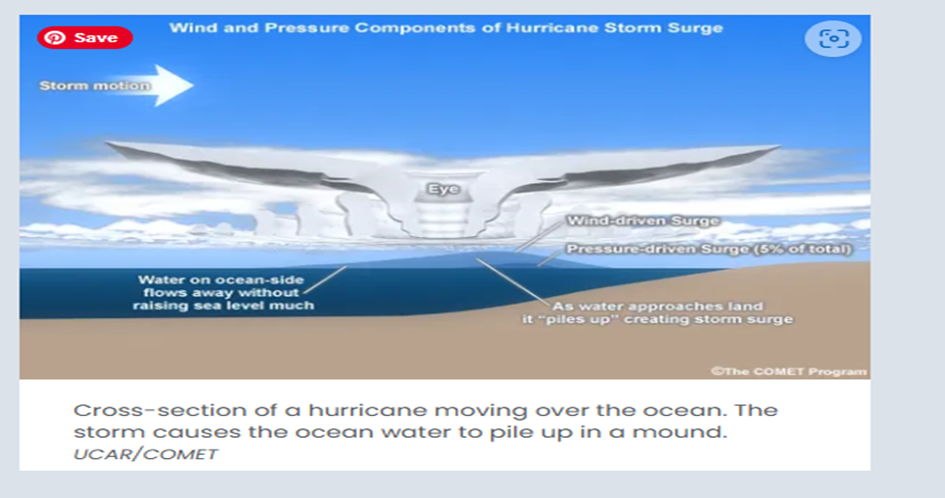
As storm surge, the temporary rise in sea level beneath a storm, becomes dangerous when the storm — typically a hurricane or other tropical storm — reaches land. The water is unable to escape anywhere but onto land as the storm moves toward the shore, which causes flooding along the coast and other types of hurricane damage. For example, the force of waves and currents can cause land to erode and buildings to be destroyed. Saltwater that gets into freshwater lakes, streams, and aquifers is hazardous to aquatic life and contaminates drinking water.
Wind piles up the water.
As winds swirl around a hurricane or tropical storm, seawater is pushed into a mound at the storm’s center. Faster wind is able to pile up more water. Because wind speed determines a hurricane’s category according to the Saffir-Simpson Scale, Category 4 and 5 storms are able to produce a larger mound of water than Category 1 and 2 storms. The mound of water isn’t noticeable out at sea, but as it approaches a coast, the impact is seen as storm surge flooding.
3. Impacts – the Water Cycle
Extract from UK and Global extreme events – Heavy rainfall and floods – Met Office:
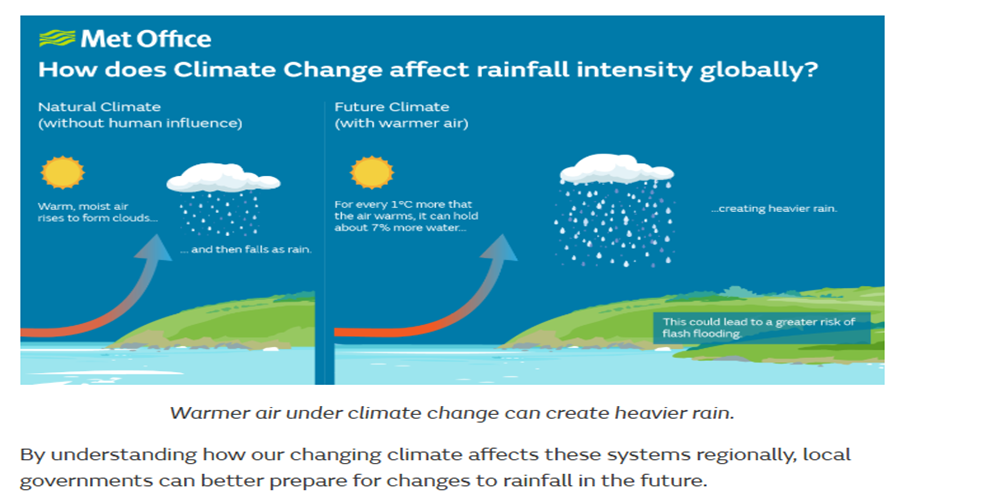
Climate change affects evaporation and precipitation.
Extract From The Water Cycle and Climate Change | Center for Science Education
Climate change is likely causing parts of the water cycle to speed up as warming global temperatures increase the rate of evaporation worldwide. More evaporation is causing more precipitation, on average. We are already seeing impacts of higher evaporation and precipitation rates, and the impacts are expected to increase over this century as climate warms.
Higher evaporation and precipitation rates are not evenly distributed around the world. Some areas may experience heavier than normal precipitation, and other areas may become prone to droughts, as the traditional locations of rain belts and deserts shift in response to a changing climate. Some climate models predict that coastal regions will become wetter and the middle of continents will become drier. Also, some models forecast more evaporation and rainfall over oceans, but not necessarily over land.
Warmer temperatures associated with climate change and increased carbon dioxide levels may speed plant growth in regions with ample moisture and nutrients. This could lead to increased transpiration, the release of water vapor into the air by plants as a result of photosynthesis.
Changing Regional Precipitation
Extract from Climate Change: Regional Impacts | Center for Science Education
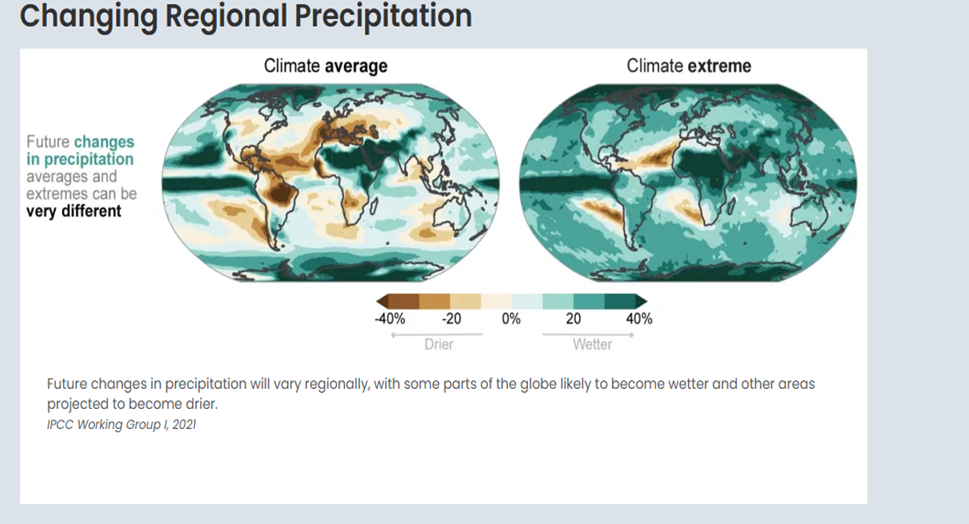
Future changes in precipitation will vary regionally, with some parts of the globe likely to become wetter and other areas projected to become drier.
IPCC Working Group I, 2021
As temperatures continues to warm, global average precipitation will also increase by the end of the century. This increase is not, however, expected to be distributed evenly around the globe or throughout the seasons in a given year. Many parts of the world could experience increases in the frequency and intensity of extreme, heavy rain events, and in other parts of the world, dry conditions may become more severe and last longer.
Much of the increase in precipitation is expected to occur at high latitudes. Increased snowfall near both poles may offset some of the melting of glaciers and ice sheets in these regions by adding fresh ice to the tops of these features. Some places in Antarctica are even gaining more snow via increased precipitation than they are losing to melting caused by rising temperatures.
However, many regions near the equator and at mid-latitudes are expected to see decreases in precipitation. In Africa, between 75 and 250 million people are projected to be vulnerable to drought and lack of drinking water. Dry conditions are already making it difficult to grow crops in Africa, which is causing more food scarcity. In some areas of Asia, clean freshwater is projected to become more scarce, and illness caused by unclean water is projected to increase.
Some of the increased rainfall is expected to come in the form of more frequent heavy downpours. Some regions may receive a net increase in rainfall, but the increase may manifest itself as heavier rains punctuated by longer dry spells between these deluges. This change in precipitation patterns is likely to cause a greater incidence of flooding, especially in combination with land use changes such as deforestation.
Many areas, especially in low- and mid-latitude regions, are expected to suffer from more frequent and more severe droughts. Dry conditions, warmer temperatures that produce longer “fire seasons”, and changes to ecosystems are expected to generate more and larger wildfires in some areas.
Drought
Extract From UK and Global extreme events – Drought – Met Office
In the simplest terms, drought is defined by a lack of water. Unlike most other extreme weather, drought tends to build up over time and can last from as little as a few weeks up to several years.
The severity of drought is usually measured both by its impact on human activities, such as agriculture and leisure, and by its effect on large-scale natural events such as wildfires. The Intergovernmental Panel on Climate Change uses four common types of drought:
- Meteorological drought – when rainfall in an area is below average for the region
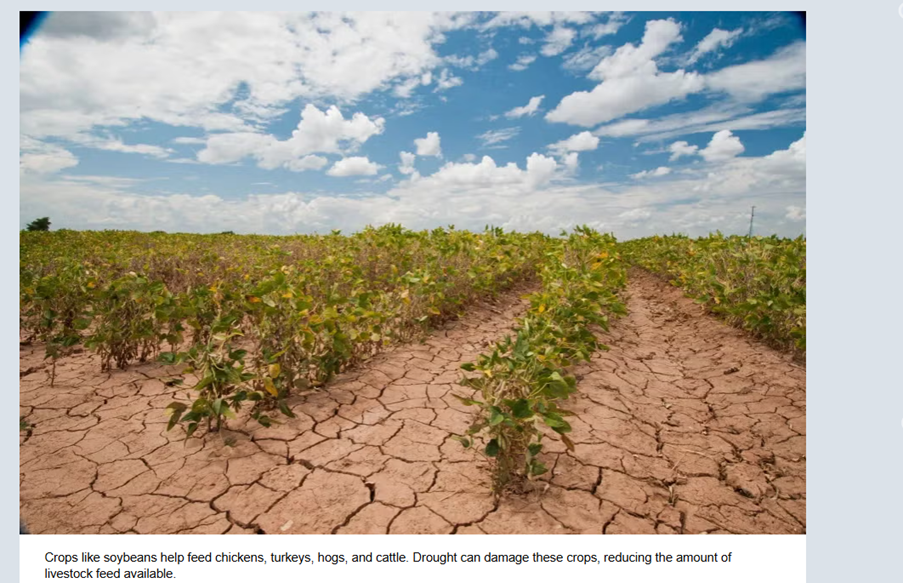
- Agricultural drought – when lack of rainfall or dry soil affects farming and crop growth
- Ecological drought – like agricultural drought, but when lack of water affects the local environment as well
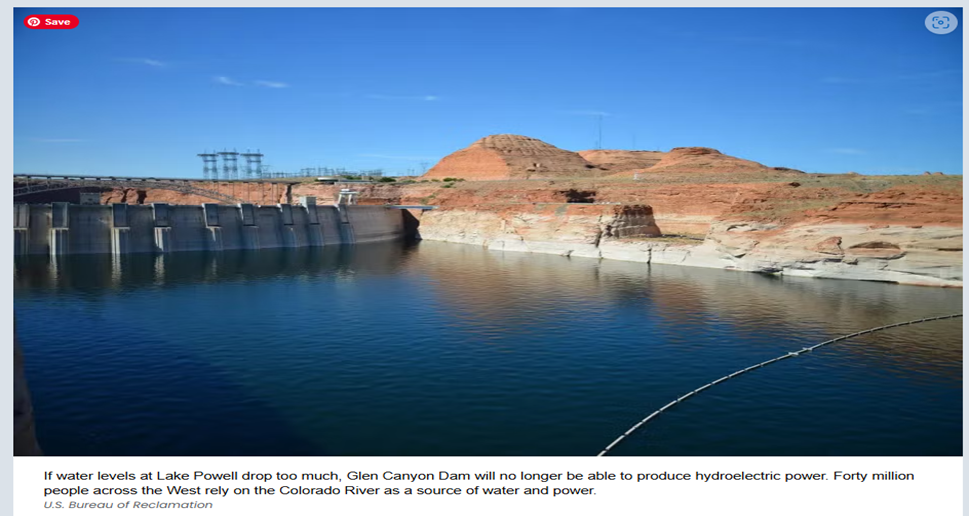
- Hydrological drought – when water supplies such as streams and reservoirs are low, which can be caused by low rainfall, lack of snow melt, or other reasons
Global Projections
The IPCC AR6 has reported that the areas affected by drought will increase in size with higher global temperatures. Even if warming is stabilised at 1.5–2.0 °C several regions are expected to experience more frequent and severe droughts.
Regions that are already suffering from a lack of rainfall are expected to further worsen. Under a high emissions scenario, regions affected by meteorological, agricultural and ecological drought could expand as far as Central America and the Caribbean, most of South America, most of Africa, the Mediterranean and central eastern Europe, and southern and eastern Australia. Only a small number of regions are expected to experience a reduction in meteorological drought.
Hydrological drought is most likely to affect regions that rely on snowmelt or are downstream of melting glaciers. However, due to large amounts of uncertainty it is difficult to predict with confidence how river flows will change.
Images from Drought: When Water Is Scarce | Center for Science Education
MCL – January 2025 (next update schedule: Spring 2028; more regular updates in the ‘Latest News Section’)
4. Recent news – Links
Climate Junction Posts
Science:
Factcheck: Why the recent ‘acceleration’ in global warming is what scientists expect – Carbon Brief ‘increasing evidence of an acceleration in the rate of warming over the past 15 years….But, as long as global emissions of CO2 and other greenhouse gases fail to decline and the world continues to tackle aerosol pollution, the world will likely warm faster than experienced in the past.’
Advances and challenges in understanding compound weather and climate extremes (phys.org)
Hurricanes:
Supercharged storms: how climate change amplifies cyclones (phys.org) -October 2024– ‘On average, the destructive potential of hurricanes has increased about 40 percent due to the 1 degrees Celsius (roughly 2 degrees Fahrenheit) warming that has already taken place, – need new cat 6 for monster storms (exeeeding 308kmp or 192miles!!] esp dangerous when intensifies close to coast’
Drowned by hurricane, remote N.Carolina towns now struggle for water (phys.org) 7 Oct 2024
Hurricanes, storms, typhoons… Is September wetter than usual? (phys.org)
Drought:
Climate warning as world’s rivers dry up at fastest rate for 30 years | Water | The Guardian – 7 Oct 2024
Global water crisis leaves half of world food production at risk in next 25 years | Water | The Guardian – 17 Oct 2024
Droughts in Europe could be avoided with faster emissions cuts (phys.org)
Floods:
Climate extremes in 2024 ‘wreaking havoc’ on the global water cycle – 6 Jan 2024
Heatwaves:
Earth has just ended a 13-month streak of record heat – here’s what to expect next– 14 Aug 2024
My life at 50C: India’s new reality of extreme heat | The Independent – 30 Aug 2024
Tenth consecutive monthly heat record alarms and confounds climate scientists | Climate crisis | The Guardian – 9 Apr 2024
‘Gobsmackingly bananas’: scientists stunned by planet’s record September heat | Climate crisis | The Guardian – 5 Oct 2024.